The holiday arrives. Your competitors collect in sales like there’s no tomorrow. Meanwhile, your Google Ads campaigns just sit there gathering digital dust.
Frustrating, right? Here’s the thing: seasonal Google ads aren’t rocket science. You have to plan right and execute it at the perfect time.
In this guide, we will help you understand how to plan ads around holidays, local events, and peak shopping seasons. In the meantime, we’ll show you practical ways to grab more clicks and boost conversions. Ready to turn those quiet months into profit machines? Let’s get into it.
Why Seasonal Google Ads Outperform Year-Round Campaigns
Seasonal campaigns target the exact moments when buyers are ready to spend. So, the difference in ad conversion rates can be massive. (Holiday shoppers don’t browse aimlessly; they search with intent.)
Ever noticed your competitors seem to vanish during peak shopping seasons? You think they’re gone, but they’re not. They’re just getting cooler and advanced ideas with their ad spend.
The thing is, holiday shoppers are ready to spend money on a right-now basis. Your ads meet them exactly when they’re most likely to click that “buy” button. Want proof that this works? Google’s data reveals that advertisers who switched to optimised seasonal strategies saw conversion values jump 25% during peak holiday shopping periods.
And here’s something most businesses miss: there’s less competition during planning phases. While others struggle at the last minute, you can lock in lower costs early. Event-based marketing lets you ride these natural demand spikes without fighting for attention throughout the year.
Plan Your Event-Based Marketing Campaign Calendar
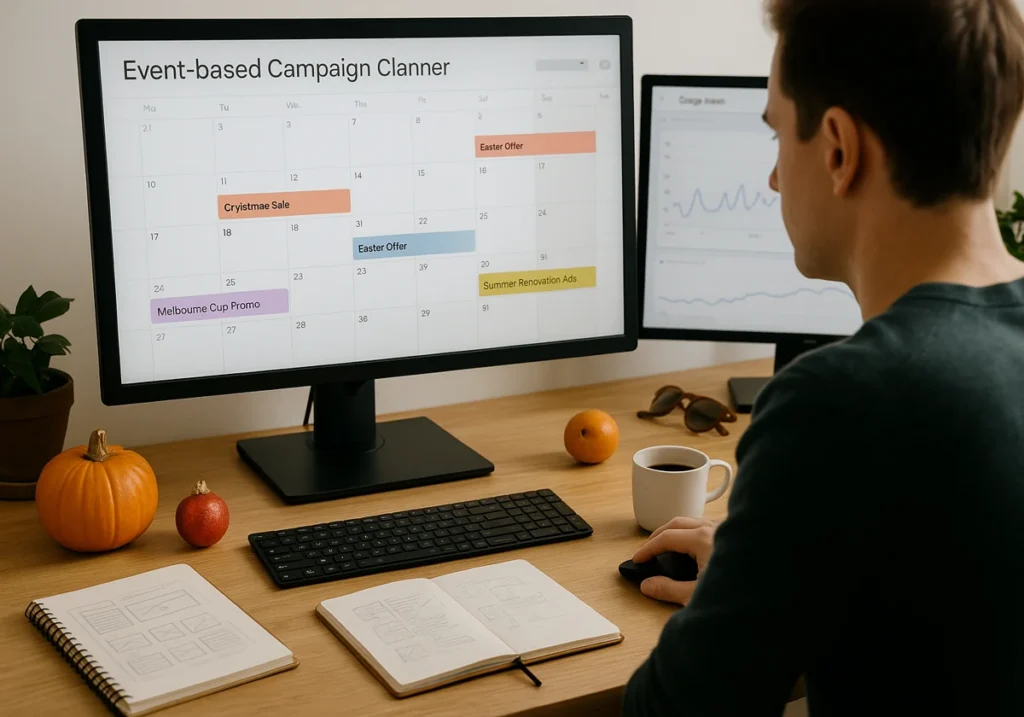
You might be thinking now: when should I start my holiday PPC strategy? The answer might surprise you.
Most businesses wait until the event starts. But that’s already too late. If you want a proper sale, you need at least four to six weeks of lead time before major holidays hit. So, start planning now, not when everyone else panics.
To start the planning, map out the big dates for your business first. Christmas and Easter are obvious ones for retail buyers. But don’t ignore Australian-specific events like EOFY sales or Melbourne Cup promotions.
Let’s talk about the service-based businesses. They can target tax season or summer renovations. The reason is that each industry has its own goldmine moments waiting to be tapped.
Want to know how to find your market pattern? Use Google Trends, and it will spot your best-selling time. You can easily type your main services or products in Google Trends and watch when searches spike. These peaks will tell you exactly when your potential customers start planning.
From our experience, businesses that plan their event-based marketing campaign early capture more opportunities, since 30% of consumers start holiday shopping as early as October or earlier. (and trust us, they’re not waiting around for your last-minute campaigns.)
Setting Up Your Google Ads Account for Seasonal Success
Most businesses make one big mistake: they try to force seasonal campaigns into their existing account structure. This creates a messy nightmare when you’re trying to track what actually works during busy periods.
To ignore this problem, you can create separate campaigns for each major holiday or event. This strategy keeps your data clean and your budgets controlled. Another advantage is worth mentioning: you can pause, adjust, or scale these campaigns without touching them. As a result, you are always advertising.
Here’s your setup checklist:
- Build dedicated seasonal campaigns: Don’t mix your holiday deals with regular promotions.
- Configure seasonality adjustment settings: Tell Google when to expect major changes in your conversion rates.
- Schedule budget increases ahead of time: Always set automated rules so you don’t miss the peak rush.
- Enable proper conversion tracking: Know which holiday-specific ad copy can drive your sales the most.
Here’s an example: We worked with a Brisbane-based furniture store. During the holidays, they created separate campaigns for each holiday season. Instantly, it helped their Easter campaign cost decrease by 22% per conversion than Christmas. That data shaped their entire strategy for future events.
Preparing Holiday-Specific Ad Copy That Converts

Holiday shoppers respond to the urgency in your ad copy. That’s why your event-based marketing language has to match the moment. Now, what kind of language works best? Well, keep reading to know.
During holiday sale periods, use words like “limited time” and “while stocks last” to trigger immediate action. These direct communications beat vague promises. These call-to-action words tell your customers exactly what they get and when the offer ends.
The reality is: a generic ad copy kills your conversion rate faster than anything else. In this case, test at least three variations of your holiday ads. Among the three, one focuses on the discount percentage, another highlights free delivery, and a third emphasises the limited availability.
Our own testing says ads with specific numbers (“Save $150”) outperform percentage-based offers by roughly 18%.
(Pro tip: match your ad copy to your landing page message. Otherwise, when customers click and see different information, they bounce faster than a kangaroo on a trampoline.)
Using Seasonality Adjustment to Control Your Ad Spend
Now, let’s talk about the features most advertisers ignore: seasonality adjustments. This tool tells your Google Ads account to expect big shifts in consumer behaviour during specific dates.
Smart bidding relies on historical data, but what happens when the holiday season throws normal patterns out the window? Seasonality adjustment solves this exact problem.
When you inform Smart Bidding that conversion rates will change dramatically during your event. Then, Google adapts your bid strategies in real time. The result? You don’t have to waste money on overbidding or missing opportunities by bidding too low.
Here’s how different campaigns respond:
Campaign Type | Normal CPA | Seasonality Adjustment | Expected CPA During Peak |
Retail Products | $45 | +25% conversion lift | $36 |
Service Bookings | $80 | +15% conversion lift | $70 |
Last Minute Deals | $55 | +40% conversion lift | $39 |
That’s how you can set your new seasonality adjustment at least three days before the event starts. These adjustment gives time to Google’s algorithm to learn and adapt your budgets properly. Many businesses make a big mistake by activating it too late. That’s why, when the busiest time hits, their campaigns still haven’t adjusted yet.
Capturing Last Minute Holiday Shoppers

You think the shopping rush ends two weeks before Christmas? That’s not true at all.
Because we’ve seen some of the highest conversion rates happen in those final 72 hours. Sometimes, last-minute customers search, and they pay premium prices for speed and convenience. They are known as eleventh-hour shoppers.
So if you follow a few strategies, it shifts dramatically for these eleventh-hour shoppers. Focus on immediate fulfillment options like same-day delivery or click-and-collect. Put these options front and centre in your ads. Because these customers don’t care about browsing, they want solutions now.
(Pro tip: To capture last-minute shoppers, increase your mobile bids by 20-30%. Why? Because these searches happen on phones while people are out and busy.)
Believe it or not, retargeting becomes most powerful in this situation. Imagine someone visited your site earlier but didn’t buy anything. No problem! Hit them with urgent messaging about stock running low.
Start Planning Your Seasonal Wins Today
Seasonal Google Ads give you a genuine advantage when planned properly. Now, you’ve the roadmap:
- First, map your event calendar early for the upcoming holidays.
- Then, structure your Google Ads account for easy management.
- Craft interesting holiday-specific ad copy and test it.
- Finally, use seasonality adjustments to control costs.
The cost of ignoring seasonal campaigns? It’s massive. While you stick to the same strategy throughout the year, your competitors are capturing customers during their highest-intent moments.
So, pull up to your Google Ads account right now and mark your next three seasonal opportunities. Block time to create those campaigns four weeks before each event occurs. And the good news is: you are not alone in this journey.
Reach out to our SlamStop team. We help businesses to implement these exact strategies. We’ve guided dozens of companies through their first holiday PPC campaigns and watched their conversion rates climb. There’s a difference between floating it and having a solid plan that shows up immediately in your data.