Google Ads Mistakes

The Most Common Google Ads Mistakes and How to Fix Them

Ever launched a Google Ads campaign only to watch your budget vanish with nothing to show for it? Yeah, it happens with most businesses.

In fact, many businesses across Australia lose thousands monthly because of simple Google Ads mistakes that could’ve been avoided from day one. And the worst part is, most of this wasted ad spend comes from setup errors you can fix yourself.

We’ve worked with hundreds of businesses struggling with online advertising, and the same problems keep appearing. Wrong keyword targeting, missing conversion tracking, and poor campaign structure drain budgets faster than you’d expect.

This article breaks down the major Google Ads mistakes beginners make and shows you exactly how to stop wasting money.

Stay with us to learn where your ad spend goes and which fixes deliver real results.

Conversion Tracking: The Setup Most Businesses Ignore

Conversion tracking measures which clicks turn into sales, phone calls, or form submissions for your services. It shows you exactly what amount your ad spend produces and which customers your Google Ads account actually brought in.

The truth is, most businesses skip this step completely. They launch campaigns without proper tracking and then wonder why nothing seems to work. You’re spending money daily but have no clue which keywords bring paying customers versus window shoppers who just browse and leave.

Here’s what makes this worse. When you import conversions from Google Analytics instead of setting up native tracking in your Google Ads account, you get incomplete revenue data. The performance data doesn’t match up, and you can’t see which ads generate sales.

That’s why you need to fix conversion tracking straight away before you spend another dollar. Without it, tracking conversions properly becomes impossible, and you’re basically guessing where your money goes.

Negative Keywords: The Fast Fix for Wasted Spend

Negative Keywords: The Fast Fix for Wasted Spend

Negative keywords stop your ads from showing on irrelevant searches, which saves you money on clicks that were never going to convert.

We’ve found through hands-on work that businesses lose hundreds of dollars monthly because they never add negative keywords to their Google Ads campaigns. Your ads appear for searches like just the letter “C” when you sell printer cartridges (this happens more often than you’d think). Each useless click costs money, and the traffic goes to the wrong people entirely.

Without a negative keyword list, Google shows your ads to anyone remotely related to your product. So you need to block irrelevant searches before they drain your budget.

The good news is that this fix only takes minutes. You just open your Google Ads account, click on Keywords in the left menu, then select Negative Keywords. Add the terms you want to exclude, and Google stops showing your ads for those searches immediately.

Useful Tip: Add negative keywords weekly based on what you see in your search terms report. If you notice wasted spend on certain phrases, add them as negatives right away to stop the bleeding.

What Does Your Search Terms Report Tell You?

The search terms report shows the exact phrases people typed into Google before clicking your ad. That means it reveals what users actually searched for, showing mismatches between your intent and Google’s interpretation of your keywords.

You may even find out your coffee shop ads trigger “espresso machine repair” searches, which explains why no one buys. That’s wasted budget on irrelevant searches you never wanted.

And believe it or not, most accounts ignore this report because they don’t realise how much money it saves them. They miss both money-wasting search terms and high-performing ones to expand on.

The report basically tells you how users found your ads and whether Google understood your keywords correctly. Which is exactly why you should check your search terms weekly to spot problems early.

Once you understand what triggers your ads, you’ll notice patterns in user behaviour that point to other important issues with how your keywords are set up in the first place.

Keyword Match Types Explained for Beginners

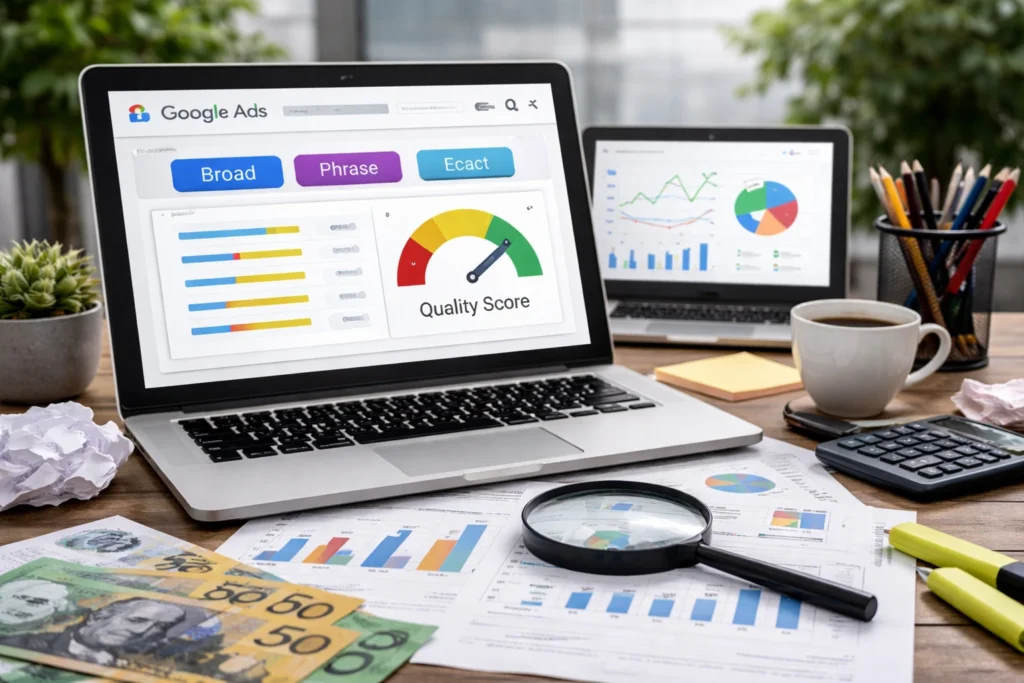
Keyword match types control how closely a search query needs to match your keywords before your ads appear.

Google gives advertisers three targeting options: broad match, phrase match, and exact match. Each one affects how much traffic your campaign gets and which potential customers see your ads.

Let’s break down the two common mistakes people make with match types:

1. Using Only One Match Type Limits Reach

Mixing match types helps you reach more potential customers without losing control over who sees your ads. That means, if your campaign only uses exact match keywords, you need to add phrase and broad match variations to get in front of more relevant searches.

Google recommends mixing broad, phrase, and exact match keywords to balance control with reach. The right combination lowers your cost per click while expanding your targeting beyond just one approach.

Meanwhile, sticking to exact matches only means you miss variations of search terms your customers type in. While your competitors capture relevant traffic from related searches, your ads stay hidden from buyers.

2. Too Many Keywords Per Ad Group

Ad groups where you stuff with dozens of unrelated keywords make it harder for your ad copy to match what people searched for.

Cramming 40 keywords into one ad group means your Google Ads can’t match what people searched for. And when that happens, Google penalises mismatched ads with lower Quality Scores. Ultimately, it just drives up what you pay for every single click.

In our experience, keeping under 20-25 tightly related keywords per group improves how relevant your ads appear. Smaller groups help your campaign deliver better results because each ad speaks directly to what users want.

Wrong Keyword Grouping Kills Quality Score

Quality Score measures how well your keywords, ads, and landing pages match each other and the searcher’s intent. It’s basically Google’s way of grading how relevant your entire setup is to what people want.

This is where most people go wrong with their Google Ads campaign. Putting “men’s hoodies” and “blue t-shirts” together confuses Google about what your ad really promotes. Your Quality Score drops because your ad about hoodies sends people to a page selling t-shirts, which creates a mismatch that Google penalises.

Every click can cost 30-50% more when the Quality Score is low, since Google charges more for ads it thinks aren’t helpful to searchers.

The solution: perfect targeting starts with keeping related keywords together so your ads match what people searched for.

For example, create one ad group just for “men’s hoodies” with keywords like “buy men’s hoodie,” “men’s pullover hoodie,” and “hoodie for men.” Then make a separate group for t-shirts with its own focused keywords. This tight grouping tells Google exactly what you’re selling and who should see each ad.

Trust us, when you organise keywords this way, your cost per click drops noticeably, and your ad spend delivers better results.

Why Your Ad Copy Gets Ignored (And Wastes Clicks)

Ad copy is the text people read before deciding whether to click your ad or skip it entirely, and most businesses write copy that sounds like everyone else’s.

Generic headlines like “Buy Now” or “Best Prices” don’t tell target audiences why your business is different from competitors (we’ve all been there). These ads could work for any company, which means nothing catches the eye of users scrolling through Google Ads results.

Your ad lacks a clear benefit statement, so people skip it to click on ads that promise something specific to their needs. That’s where understanding consumer behaviour helps. Potential customers want to know what they get before clicking, not after.

Yet, most marketers miss this completely. They’re paying for an ad position but getting low click-through rates because the copy feels identical to every other ad. The result is wasted ad spend on impressions that never turn into clicks.

Good ad copy needs to deliver results by showing value upfront. But even the best ads fail if they send people to the wrong place.

Landing Pages That Lose You Money

Sometimes the simplest mistakes cost the most money with landing pages. You may not even realise your site is pushing away the traffic you’re paying for.

Here’s how landing pages kill your conversions:

  • Mismatched Messages: If your ad promises free shipping, but the landing page doesn’t mention it anywhere, people bounce immediately because they feel misled.
  • Mobile Problems: Most Google Ads traffic comes from phones these days (more than 62% in the second quarter of 2025). So your landing pages need to work perfectly on mobile, or you’re throwing money away. Visitors also leave when buttons don’t work, or text is too small to read on mobile screens.
  • Slow Loading: Slow loading times mean people abandon your landing pages before they even appear. In fact, 32% of users leave sites that take longer than three seconds to load. You’re paying for each click but losing conversions because the page takes forever to load.

Bottom Line: Fix your landing pages so ads and content match. When they work together, users stick around, and your Google Ads spend actually delivers results.

Landing Pages That Lose You Money

Where Does Your Google Ads Budget Go?

Most business budgets leak money through location settings, time-of-day bidding, and device targeting that wasn’t configured properly.

Let’s be real here. You set location targeting to Brisbane, but your Google Ads still show to people 50km outside your service area. That’s wasted budget on paid advertising that reaches the wrong geographic location entirely (and the damage adds up fast).

Half your ad spend drains after business hours when no one’s available to answer calls from your ads. The thing is, Google keeps running your campaigns 24/7 unless you schedule specific hours. So poor targeting like this is one of the common reasons Google Ads campaigns fail to deliver conversions.

On top of that, desktop bids match mobile bids even though mobile traffic converts at half the rate for your business. You’re spending the same amount per click on both devices, but mobile users might just be browsing while desktop users are ready to buy. That difference costs you money on every mobile click that goes nowhere.

These targeting mistakes create wasted spend you don’t even notice until you check where the money goes each month.

Start Fixing These Mistakes Today

Google Ads mistakes like missing conversion tracking, ignoring negative keywords, and poor landing pages drain thousands monthly from Australian businesses. However, you can fix each one this week and stop the wasted ad spend immediately.

Start with conversion tracking since you can’t improve a campaign without knowing what works. Then add negative keywords, clean up your keyword grouping, and match your landing pages to your ads. These changes build a stronger strategy that delivers results.

Don’t wait until down the track when your budget’s gone. Businesses that fix these Google Ads mistakes early see a strong ROI from digital advertising.

If you need help getting your campaigns running properly, contact us at SlamStop. We’ve helped hundreds of businesses across Australia turn failing campaigns around.

PPC Audit Guide

How to Audit a Google Ads Account Like a Professional

A Google Ads pay-per-click audit (shortly known as PPC audit) involves reviewing your account structure, keyword intent, and how ad spend flows through the funnel. This approach directly links campaign setup to landing page performance while identifying inefficiencies and clearer optimisation opportunities.

But it’s not that simple because most people usually focus on the less important elements and waste money. We’ve been auditing Google Ads accounts for years, so we know exactly where it goes wrong.

In this guide, we’ll walk you through the complete audit process. Plus, we’ll show you the most common issues that ruin your PPC performance and teach you how to prioritise fixes for the best output.

Read on to learn how to take control of your campaigns and improve efficiency.

How to Review Your Google Ads Performance

You review your Google Ads performance by checking seven main areas in order: conversion tracking, account structure, search terms, Quality Score, keyword match types, budget distribution, and ad copy. Most audits take two to four hours, depending on your account size.

How to Review Your Google Ads Performance

Here’s how you should audit your Ads account:

  • Conversion Tracking and Analytics: Make sure conversions trigger on the right pages after someone completes a desired action. Then connect your Google Ads account to Google Analytics so you can follow what happens next, from the initial click-through to the outcome.
  • Account Structure: Properly organised campaigns give you more control over budget and deliver higher quality scores. That’s why you need to separate campaigns by product type or target audience to prevent mixing unrelated keywords. Each ad group should target tightly themed keywords that share the same intent.
  • Search Terms Report: The search terms report shows the real phrases people type before seeing your ads, compared to the keywords you target. For example, a plumber bidding on “emergency plumbing” may appear for “plumbing courses” or “plumbing jobs”, which leads to irrelevant clicks and wasted ad spend.
  • Quality Score and Landing Pages: Your Quality Score directly influences how much you pay per click and how competitive your ads are in the auction. Higher scores often lead to lower costs and better visibility, given that your ad text, keyword intent, and landing page message are closely aligned.
  • Match Types and Negative Keywords: Keyword match types control how closely search queries relate to your targeted keywords. Broad match keywords often need negative keywords to act as a safety net. It helps keep a PPC campaign focused by refining results over time instead of relying on a fixed number at launch.
  • Budget and Bidding: You must check which campaigns use the most ad spend and how that compares to the conversion rate. Branded campaigns often bring paying customers at lower customer acquisition costs, yet many accounts still underfund them.
  • Ad Copy and Assets: Strong ad copy supported by relevant assets can improve your click-through rate by increasing relevance and clarity. We recommend including your focus keyword in headlines for better ad quality. Also, test a minimum of two ad variations per ad group consistently, and add sitelinks, callouts, and structured snippets.

When all these aspects work properly, your ads reach the right target audience and convert more potential customers.

Detailed Overview of PPC Audit

A PPC audit is a systematic review of your Google Ads account to identify wasted spend, technical problems, and missed opportunities (we discussed the techniques at length in the previous section). The goal is to find actionable insights that improve your return on ad spend.

Let’s get into more detail about the ways these audits work.

Regular Audits Reduce Wasted Ad Spend

Regular audits catch budget-draining issues before they cost you thousands in wasted clicks. They find lost budget on the wrong keywords, broken tracking, or ads showing in irrelevant searches.

We’ve found that most accounts leak one-third of their budget without anyone noticing until they run an audit.

Audits also find out which particular keywords attract potential customers versus irrelevant clicks that will never convert. For instance, a Brisbane law firm might find that they’re paying for searches like “law degree requirements” when they only want “personal injury lawyer Brisbane”.

You can also detect technical issues like broken tracking before they drain money for weeks if you perform regular checks on your Google Ads account.

Recommended Audit Frequency

The truth is, your audit frequency depends on your monthly ad spend and account complexity. In our experience, small business accounts under five thousand dollars monthly need only quarterly audits to catch issues before they become expensive problems.

Honestly, data accumulates more slowly when you’re spending less. That’s why checking every three months gives you enough information to identify certain patterns.

That said, if your account has a monthly budget of over twenty thousand dollars, you’ll need to perform checks weekly. You’ll also have to review the account every quarter to prevent budget waste at scale (especially in competitive markets).

When spending increases, a poorly set up Ad campaign can use up your monthly budget very quickly. For that reason, weekly checks help notice problems early, while quarterly reviews look more closely at strategy and account structure.

Pro tip: Run an immediate audit when your conversion rate drops suddenly, or costs spike without explanation.

What Are Common Issues Found in Google Ads Audits?

Common issues found in Google Ads audits often include poor account structure, missing negative keywords, and bidding strategies that don’t match campaign goals. From what we’ve seen, these three issues constantly appear in audits and lead to inefficient budget use.

What Are Common Issues Found in Google Ads Audits?

We’ll take a closer look at these issues.

Poor Account Structure

Believe it or not, using a single campaign for everything lowers ad quality because it mixes unrelated keywords together. So when someone searches for something specific, like “men’s running shoes”, but sees a general ad, they are less likely to click.

The same problem appears at the ad group level as well. Like, when ad groups contain more than 30 keywords (as a rule of thumb), it becomes difficult to optimise them. Why? It’s because you can’t write relevant ads for many different search intents.

But a well-organised account structure gives you more control over budget distribution. It allows you to pause underperforming ads while keeping high-performing campaigns running smoothly.

Missing Negative Keywords

If you don’t use negative keywords, irrelevant searches can trigger your ads. These incidents gradually drain your budget and reduce the overall efficiency of your ad campaign.

And the problem gets worse when you use broad match keywords without any safety net. Specifically, broad match without negatives shows ads for completely irrelevant searches that only share one or two words with your target keyword.

Take an accounting firm targeting “tax services” as an example. They might show ads for “tax refund status” or “free tax calculator”. It’ll attract people looking for DIY solutions and not professional help.

This is why you need to review search terms weekly to build comprehensive negative keyword lists. This practice will protect you from losing money.

Wrong Bidding Strategy for Campaign Goals

The right bidding strategy aligns ad spend with real business goals instead of vanity metrics. For example, Maximize Clicks bidding can waste money when conversion goals are your priority, since it focuses on volume. This way, you’ll get plenty of clicks from people who have no intention of buying.

And if you go the automated bidding way, remember that it needs sufficient conversion data first to work properly (we’ve found it to be at least 30 conversions per month). Without that volume, the system struggles to learn and often makes inefficient decisions early on.

So, match your bidding strategy to your campaign goal for the best results rather than letting Google choose for you.

How Do You Prioritise Your Audit Findings?

You prioritise audit findings by fixing urgent issues like broken conversion tracking first. After that, you should address high-impact problems like wasted ad spend and then move on to time-consuming improvements, namely testing new ad copy.

Let’s start with broken conversion tracking. You have to fix it first because you can’t measure anything without it. And when it doesn’t work, you’re spending money blindly with no idea which campaigns deliver results and which ones burn cash.

Then come the negative keywords. Deal with them next to stop bleeding your budget on irrelevant traffic. Based on our experience, it takes one to two hours to complete this task, and you’ll notice its impact almost immediately.

Another thing on the priority list is managing your Quality Score. If the score is under five, you often pay more per click because your ads are less competitive than those with higher scores. More precisely, a score of three or four signals low relevance, which means Google expects weaker alignment with what people search for.

And the penultimate one on the list is improving elements that require time, like fixing weak ad copy and optimising your dedicated landing page. These changes take more time but still deliver solid returns (and the impact lasts for a long time).

How Do You Prioritise Your Audit Findings?

Once you fix the most urgent problems, you can then focus on improving overall performance. At that point, reorganising the account structure comes last, because it takes even more time and delivers benefits gradually.

Below is an audit priority matrix to help you understand the fix order:

Issue Found

Priority

Typical Impact

Time to Fix

Broken conversion tracking

Urgent

Results can’t be measured or optimised reliably

~30 mins

Missing negative keywords

High

Significant wasted budget from irrelevant clicks

1-2 hours

Poor Quality Score (under 5)

High

Higher cost per click and reduced ad competitiveness

2-4 hours

Weak ad copy

Medium

Lower click-through rate and missed traffic potential

3-5 hours

Unorganised account structure

Low

Harder optimisation and reduced control over the budget

1-2 days

Get Better Results From Your Ads

You’ve reached the end of our guide on auditing Google Ads accounts like a professional. You now know the seven areas to check, which problems drain the budget fastest, and how to prioritise fixes based on impact and urgency.

If you’re looking for an expert to take a look at your account, don’t hesitate to reach out to our team. We’ve been managing Google Ads campaigns for years at SlamStop. Let’s refine your campaigns so every click supports your goals and call to action.

reduce your Cost-Per-Click (CPC)

How to Reduce Ad Costs Without Losing Conversions

You can reduce your Cost-Per-Click (CPC) by improving Quality Score and using better keyword targeting.

Sustainable results come from a balanced approach that combines stronger relevance with careful bid adjustments. It allows you to get more clicks from the same budget and supports stronger conversion performance.

If that sounds confusing, don’t worry. Here at SlamStop, we help businesses reduce their Google Ads costs while still keeping the conversions consistent. We simplify your campaigns so your ads reach the right people at the right time.

In this blog, we’ll walk you through how to reduce CPC through keyword optimisation. We’ll also share bidding strategies and how to analyse performance data.

Read on to learn how to stop overpaying for clicks.

How Do You Lower Your CPC in Google Ads?

You lower CPC by focusing on relevant keywords, cutting wasted spend with negative keywords, and improving your ads. Since these tactics support each other, the best idea is to combine them instead of relying on just one change.

How Do You Lower Your CPC in Google Ads

Here are the strategies to reduce your CPC:

  • Long Tail Keywords: Broad match keywords can trigger irrelevant searches that waste budget. For example, someone searching “women’s trail running shoes size 8” is more likely to buy than someone searching “shoes”, so search volume drops but conversion rates improve.
  • Negative Keywords: Check your search terms every week to detect wasted ad money. We’ve seen how a plumber targeting “emergency plumbing Sydney” often appears for “plumbing courses” or “plumbing jobs”. So you should add those terms as negative keywords to avoid losing money.
  • Quality Score: Google scores ad relevance, expected Click-Through-Rate (CTR), and landing page experience from 1 to 10. When you improve these scores, ads often cost less because Google prioritises higher-quality adverts that create a better experience for users.
  • Landing Page Match: If your ad mentions “free shipping on orders over $50”, that message should appear clearly above the fold on your landing page. When messages don’t match, users leave quickly, which can negatively affect Quality Score over time.
  • Assets: Since you’re already paying for the click, you should give searchers more reasons to choose your ad. We recommend using sitelinks and callouts because they can increase visibility on search engine results pages.

These tactics create more efficient Google Ads campaigns that cost less while delivering higher-quality traffic.

What Bidding Strategies Reduce CPC?

Bidding strategies that reduce your cost-per-click include manual CPC and automated bidding with maximum CPC limits. The best option for you between them depends on how much conversion data you have and how much control you want over your bids.

Let’s get into more detail about these bidding strategies.

Set Maximum CPC Limits on Automated Bidding

Some campaigns can see CPC rise well above the average, for which many people rely on automated bidding. But there’s a problem with this strategy. Google may bid higher when it predicts a strong chance of conversion, and it can sometimes result in paying a lot more for a click than usual.

The solution is to use portfolio strategies. They let you limit your maximum CPC on Target ROAS or Target CPA campaigns.

For example, if your average CPC is $3, you can set your max limit between $9 and $15. It gives the algorithm room to bid up for high-value clicks while protecting you from budget-draining spikes.

Try Manual CPC for New Campaigns

New campaigns usually lack enough conversion data for automated bidding to work well. While there’s no fixed minimum, these systems perform better once more data is collected. Until then, manual bidding helps you control costs and avoid overspending early on.

Try Manual CPC for New Campaigns

Now, to set up manual CPC, you need to check which keywords bring conversions at a reasonable cost each week. Then increase your bids by 10 to 20 per cent on those terms (it’ll prevent runaway bid escalation).

As a rule of thumb, you can switch to automated bidding once you’ve got consistent conversion volume (often around 30-50 in recent weeks). The algorithm finally has enough information to optimise properly.

Here’s a quick comparison table to give you a better understanding of available bidding strategies:

Bidding Strategy

Best For

Control Level

When to Use

Manual CPC

New campaigns, testing

Full control

Limited conversion data

Automated with Max Limits

Mature campaigns

Controlled automation

Prevent cost spikes

How Do You Use Performance Data to Cut Costs?

You can cut costs by looking at what’s actually working in your data and then adjusting bids for the right times, locations, and devices. This way, you spend more on what works and less on what doesn’t.

We’ll explain how to use your performance data correctly.

Adjust Bids by Time and Day

Did you know your conversion data shows which hours and days deliver the best results? For instance, you might be paying for clicks at 2 AM when no one is buying, while missing peak hours when your target audience is actively searching.

So, take a look at your “When and where ads showed” report to find your best-performing time slots. If conversions cost $45 between 11 PM and 6 AM but only $28 during business hours, you’re ultimately wasting money.

That’s why we recommend actively decreasing bids during low-performing times to reduce wasted spend and increasing them when conversion rates are the highest.

Target High-Converting Locations

Location reports show which areas deliver the best cost per conversion. To give you an idea, a Sydney campaign might find that North Sydney converts at $32 per lead while Parramatta costs $58. Same city and same ads, yet you’re seeing a completely different performance.

Here’s what you need to do: adjust your bids down for locations with high CPC but low conversions. Honestly, you don’t need to exclude these areas entirely. Just reduce what you’re willing to pay.

Also, don’t forget to focus your budget on regions where your target audience actually converts. Spending money evenly everywhere is how many companies lose their budgets, which we see frequently in our audits.

Pro tip: Apply smaller bid changes first, then measure impact over at least two weeks before scaling.

Optimise for Best-Performing Devices

Device performance can differ a lot across phones, desktops, and tablets, so results aren’t always the same. In many cases, people research on mobile but wait until they’re on a desktop to complete a form or enquiry.

Optimise for Best-Performing Devices

As an example, someone might be researching lawyers on their phone during lunch. However, they often wait until they’re home on a desktop before submitting a contact form.

What can you do then? Well, check device performance weekly and adjust bids based on conversion rates and cost per conversion. In our experience, if mobile brings cheap clicks but desktop converts at twice the rate, increasing desktop bids by 15 to 25% is usually enough.

Your Next Steps to Lower Ad Spend

We’ve reached the end of our guide on reducing CPC without losing conversions. You now know that Quality Score improvements and negative keywords deliver quick wins, while bidding strategies give you long-term control over costs.

Remember that you don’t need to do everything together. Start small by checking your search terms for one week, then add negative keywords the next to stop wasted clicks. After that, review your Quality Score and fix anything hurting your ad rank.

And if you want the expert to optimise your Google Ads campaigns, don’t hesitate to contact us at SlamStop. Our team will help you cut costs while maintaining conversions.

Google Ads 2026

Why Google Ads Is Still One of the Fastest-Growing Channels in 2026

Google Ads is still one of the fastest-growing digital marketing channels in 2026 because it captures high-intent search traffic from people actively looking to buy what you sell. The platform delivers results in days, which is why businesses keep coming back to it.

We’ve been managing Google Ads campaigns for years at SlamStop. So we understand why some businesses succeed financially while others waste resources.

In this article, we’ll cover:

  • Why Google Ads still delivers fast growth
  • Google Ads changes in 2025
  • How small businesses compete and win with Google Ads
  • When you should avoid Google Ads entirely

Ready? Let’s begin.

Why Is Google Ads Still One of the Fastest Growth Channels?

Google Ads remains one of the fastest-growing channels, as it targets people who are looking to purchase from you immediately. It places your business in front of them at the exact moment they are searching, and it leads to quicker sales.

Why Is Google Ads Still One of the Fastest Growth Channels?

Here are the four main reasons why companies keep using Google Ads:

  • High Purchase Intent: People search on Google when they need to buy something now. For instance, someone typing “emergency plumber Brisbane” isn’t browsing casually. Rather, they’ve got water flooding their kitchen and need help within the hour.
  • Immediate Results: If you launch your first ad campaign on Monday morning, you’ll see website visitors clicking through and generating leads by lunchtime. This quick impact is important for small businesses to test new markets and increase brand awareness without waiting six months for organic traffic.
  • Conversational Search Reach: We’ve seen that voice search has changed how people find businesses. Instead of typing short phrases, they now ask full questions on their phones, like “Where can I find fresh sourdough near me?” Google’s AI automatically shows your digital advertising for these natural and spoken searches.
  • Cost-Effective Targeting: The average cost per click rose in 2025, though not for everyone. Specifically, advertisers who use signal-driven targeting pay less. That’s because Google analyses behaviour and location data to reach the right target audience instead of wasting ad spend.

When KW usage aligns with intent and timing, Google Ads becomes a consistent growth channel.

What Changed in Google Ads During 2025?

Google Ads moved from manual control to AI-driven automation across every campaign type during 2025. This is when this platform stopped treating artificial intelligence as an optional helper and made it the foundation of how initiatives work. And advertisers who adapted early gained a competitive edge over those who resisted this change.

We’ll explain these important changes now.

AI Now Drives the Entire Platform

Automation now handles campaign optimisation over all paid traffic campaigns automatically. You set your budget and conversion goals, and then the system does all the work based on your input.

For example, the AI adjusts bids hundreds of times per day based on which clicks are most likely to convert. It responds to competition changes, time-of-day shifts, and user behaviour patterns faster than you could manually (no need to worry about missed auctions anymore).

Once you’ve set up your campaign, you just need to track its performance through AI-powered insights in Google Analytics. The goal here is to find out which automated adjustments actually work well for your business.

Key 2025 Platform Updates

Four major updates changed how Google Ads will deliver results in 2026. In particular, one of the biggest shifts came from AI Overviews, which place ads inside AI-generated answers at the top of search results instead of just below them.

Another important shift is the increased use of AI-powered audience signals. Instead of relying solely on typed keywords, Google Ads now uses a combination of signals like location, device type, search behaviour, and intent patterns to better match ads with potential customers.

At the same time, Performance Max continues to play an important role. It delivers ads through Search, YouTube, Display, Gmail, Discover, and other Google properties from a single campaign. It also comes with improved reporting and controls now.

Finally, measurement and conversion tracking tools, including Enhanced Conversions, improve how accurately results are attributed and track campaign performance. This accuracy comes from securely using first-party data, which also helps guide better bidding and optimisation decisions.

Take a quick look at this table to understand what these updates mean for you:

Update

What It Does

Impact on Your Campaigns

AI Overviews

Integrates ads into AI-generated search results

Your ads can appear higher and more prominently in search

AI-Powered Audience Signals

Uses intent and behaviour data beyond keywords

Reaches relevant users you may miss with keywords alone

Performance Max

Runs digital ad campaigns across multiple Google platforms

One campaign delivers broad, automated reach

Enhanced Conversions

Improves conversion measurement using first-party data

More accurate tracking and smarter bidding decisions

First-Party Data Replaced Third-Party Cookies

With privacy changes and browser restrictions on third-party tracking, first-party data has become more important for advertising. Browsers, including Safari and Firefox, block many third-party cookies for this reason.

So, you now need to collect your own data. That means you have to grab email addresses and track user behaviour through signup forms, purchase history, and activity on your site.

How Do Small Businesses Win With Google Ads

Google Ads’ Enhanced Conversions uses this hashed first-party data. And the best part is that it improves your tracking accuracy without breaking any privacy rules.

How Do Small Businesses Win With Google Ads in 2026?

Small businesses do better with Google Ads marketing campaigns when they focus their budget on one proven offer and build data before scaling. In other words, success comes from testing one idea properly rather than testing everything at once.

Consider the steps below to get the best outcome from Google Ads:

  • Focus on One High-Margin Offer: Many small businesses waste money by trying to advertise everything at the same time. For example, a bakery promoting bread, cakes, catering, and subscriptions can’t clearly see what works. Instead, it’s better to start with the most profitable product, where the margins can easily cover ad costs.
  • Start with Search Campaigns First: Search ads reach people who are ready to buy straight away. Like, someone searching for “emergency electrician Fortitude Valley” needs help immediately and will likely contact the first business they see. For this reason, it’s best to focus on search before spending money on display or social ads.
  • Use Customer Match for Repeat Buyers: We recommend uploading your existing customer list to create retargeting campaigns at a fraction of new customer costs. Last year, a landscaping company we worked with successfully targeted the previous year’s clients with spring cleanup offers for pennies on the dollar.
  • Set Sustainable Daily Budgets: You’ll need to keep your ad budget consistent, since Google’s AI needs a steady flow of data to learn which audiences convert. That’s why if the budget is too small, the system can’t optimise properly. So, most small businesses need a meaningful daily budget to see real results.

Without thoughtful keyword usage, even well-structured campaigns can struggle to scale.

When Should You Avoid Google Ads?

You should avoid Google Ads if your profit margins can’t support pay-per-click (PPC) costs or your budget is too small to test properly. In those cases, paid ads usually don’t work well. Sometimes, the wiser choice is to wait until your business fundamentals improve.

Let’s get into more detail about the reasons.

Tight Profit Margins

Pay-per-click advertising only works with healthy profit margins. In our experience, a cafe selling $5 coffees can’t afford $3 clicks to get someone through the door when most customers buy one drink and leave.

That’s why you must calculate your profit margins to see if you can handle typical click-through rates (CTR) first before launching any campaigns. Otherwise, you’ll just burn through your budget without ever breaking even (CTR can never rescue bad margins).

Pro tip: Use exact match keywords first to avoid paying for exploratory or low-intent searches.

Insufficient Budget Commitment

If you test your ads with a minimal daily budget, it won’t allow Google to collect enough campaign performance metrics. The truth is, the algorithm needs hundreds of clicks across different times, days, and audience segments to figure out what actually converts.

Insufficient Budget Commitment

Also, it’s not a good idea to stop-start your campaigns to save money because it will confuse the system and actually waste money. Like, you can’t test for three days, pause for two weeks, then restart and expect results. It simply doesn’t work.

Put simply, constantly evolving campaigns require continuous data from sufficient website traffic. It means you need to commit to at least 30 days of consistent spending to see real patterns emerge.

Start Testing Google Ads 2026

You now know why Google Ads still delivers fast growth even today. It captures high-intent search traffic, adapts to conversational queries, and uses AI to find customers you’d typically miss. And we can’t stress how important signal-driven targeting and first-party data have become.

If you’re a small business with healthy margins, start with one proven offer and a search campaign. Focus your budget there until you’ve got solid conversion data. And if your margins are tight or you can’t commit $30-50 daily, wait until your fundamentals improve.

If you’re ready to launch your first campaign, contact us today. Our team has been working with Google Ads for a decade now. Let’s connect and see what’s possible with the right setup.

Seasonal Google Ads

How Seasonal Campaigns Can Boost Your Google Ads Results

The holiday arrives. Your competitors collect in sales like there’s no tomorrow. Meanwhile, your Google Ads campaigns just sit there gathering digital dust.

Frustrating, right? Here’s the thing: seasonal Google ads aren’t rocket science. You have to plan right and execute it at the perfect time.

In this guide, we will help you understand how to plan ads around holidays, local events, and peak shopping seasons. In the meantime, we’ll show you practical ways to grab more clicks and boost conversions. Ready to turn those quiet months into profit machines? Let’s get into it.

Why Seasonal Google Ads Outperform Year-Round Campaigns

Seasonal campaigns target the exact moments when buyers are ready to spend. So, the difference in ad conversion rates can be massive. (Holiday shoppers don’t browse aimlessly; they search with intent.)

Ever noticed your competitors seem to vanish during peak shopping seasons? You think they’re gone, but they’re not. They’re just getting cooler and advanced ideas with their ad spend.

The thing is, holiday shoppers are ready to spend money on a right-now basis. Your ads meet them exactly when they’re most likely to click that “buy” button. Want proof that this works? Google’s data reveals that advertisers who switched to optimised seasonal strategies saw conversion values jump 25% during peak holiday shopping periods.

And here’s something most businesses miss: there’s less competition during planning phases. While others struggle at the last minute, you can lock in lower costs early. Event-based marketing lets you ride these natural demand spikes without fighting for attention throughout the year.

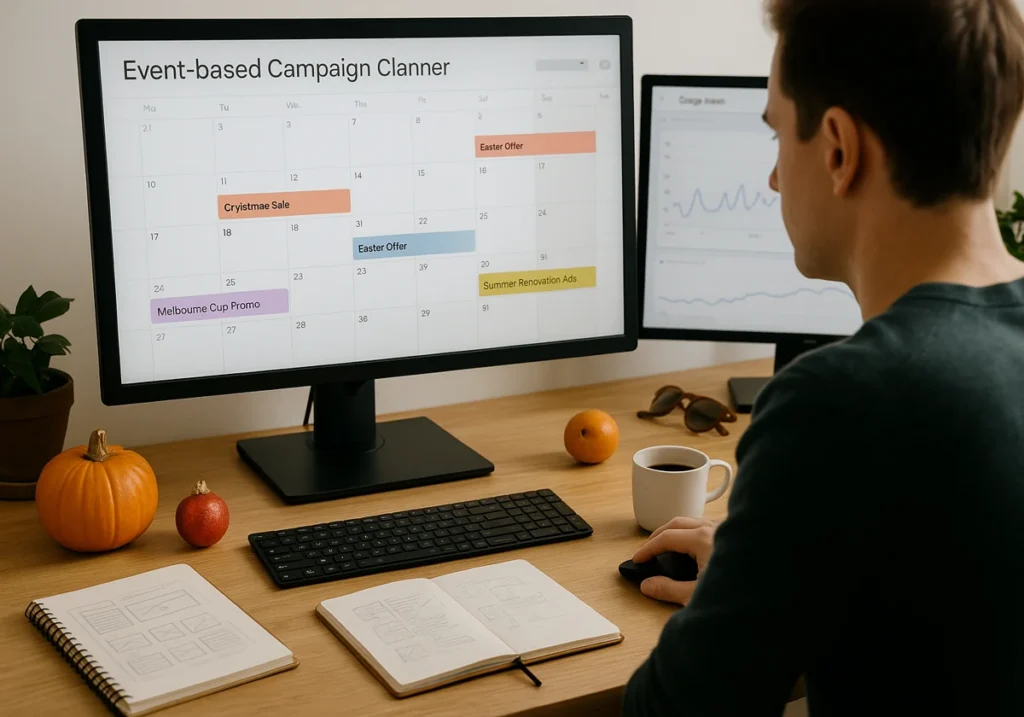
Plan Your Event-Based Marketing Campaign Calendar

Event-Based Marketing Campaign Calendar

You might be thinking now: when should I start my holiday PPC strategy? The answer might surprise you.

Most businesses wait until the event starts. But that’s already too late. If you want a proper sale, you need at least four to six weeks of lead time before major holidays hit. So, start planning now, not when everyone else panics.

To start the planning, map out the big dates for your business first. Christmas and Easter are obvious ones for retail buyers. But don’t ignore Australian-specific events like EOFY sales or Melbourne Cup promotions.

Let’s talk about the service-based businesses. They can target tax season or summer renovations. The reason is that each industry has its own goldmine moments waiting to be tapped.

Want to know how to find your market pattern? Use Google Trends, and it will spot your best-selling time. You can easily type your main services or products in Google Trends and watch when searches spike. These peaks will tell you exactly when your potential customers start planning.

From our experience, businesses that plan their event-based marketing campaign early capture more opportunities, since 30% of consumers start holiday shopping as early as October or earlier. (and trust us, they’re not waiting around for your last-minute campaigns.)

Setting Up Your Google Ads Account for Seasonal Success

Most businesses make one big mistake: they try to force seasonal campaigns into their existing account structure. This creates a messy nightmare when you’re trying to track what actually works during busy periods.

To ignore this problem, you can create separate campaigns for each major holiday or event. This strategy keeps your data clean and your budgets controlled. Another advantage is worth mentioning: you can pause, adjust, or scale these campaigns without touching them. As a result, you are always advertising.

Here’s your setup checklist:

  1. Build dedicated seasonal campaigns: Don’t mix your holiday deals with regular promotions.
  2. Configure seasonality adjustment settings: Tell Google when to expect major changes in your conversion rates.
  3. Schedule budget increases ahead of time: Always set automated rules so you don’t miss the peak rush.
  4. Enable proper conversion tracking: Know which holiday-specific ad copy can drive your sales the most.

Here’s an example: We worked with a Brisbane-based furniture store. During the holidays, they created separate campaigns for each holiday season. Instantly, it helped their Easter campaign cost decrease by 22% per conversion than Christmas. That data shaped their entire strategy for future events.

Preparing Holiday-Specific Ad Copy That Converts

Holiday-Specific Ad Copy That Converts

Holiday shoppers respond to the urgency in your ad copy. That’s why your event-based marketing language has to match the moment. Now, what kind of language works best? Well, keep reading to know.

During holiday sale periods, use words like “limited time” and “while stocks last” to trigger immediate action. These direct communications beat vague promises. These call-to-action words tell your customers exactly what they get and when the offer ends.

The reality is: a generic ad copy kills your conversion rate faster than anything else. In this case, test at least three variations of your holiday ads. Among the three, one focuses on the discount percentage, another highlights free delivery, and a third emphasises the limited availability.

Our own testing says ads with specific numbers (“Save $150”) outperform percentage-based offers by roughly 18%.

(Pro tip: match your ad copy to your landing page message. Otherwise, when customers click and see different information, they bounce faster than a kangaroo on a trampoline.)

Using Seasonality Adjustment to Control Your Ad Spend

Now, let’s talk about the features most advertisers ignore: seasonality adjustments. This tool tells your Google Ads account to expect big shifts in consumer behaviour during specific dates.

Smart bidding relies on historical data, but what happens when the holiday season throws normal patterns out the window? Seasonality adjustment solves this exact problem.

When you inform Smart Bidding that conversion rates will change dramatically during your event. Then, Google adapts your bid strategies in real time. The result? You don’t have to waste money on overbidding or missing opportunities by bidding too low.

Here’s how different campaigns respond:

Campaign Type

Normal CPA

Seasonality Adjustment

Expected CPA During Peak

Retail Products

$45

+25% conversion lift

$36

Service Bookings

$80

+15% conversion lift

$70

Last Minute Deals

$55

+40% conversion lift

$39

That’s how you can set your new seasonality adjustment at least three days before the event starts. These adjustment gives time to Google’s algorithm to learn and adapt your budgets properly. Many businesses make a big mistake by activating it too late. That’s why, when the busiest time hits, their campaigns still haven’t adjusted yet.

Capturing Last Minute Holiday Shoppers

Last Minute Holiday Shoppers

You think the shopping rush ends two weeks before Christmas? That’s not true at all.

Because we’ve seen some of the highest conversion rates happen in those final 72 hours. Sometimes, last-minute customers search, and they pay premium prices for speed and convenience. They are known as eleventh-hour shoppers.

So if you follow a few strategies, it shifts dramatically for these eleventh-hour shoppers. Focus on immediate fulfillment options like same-day delivery or click-and-collect. Put these options front and centre in your ads. Because these customers don’t care about browsing, they want solutions now.

(Pro tip: To capture last-minute shoppers, increase your mobile bids by 20-30%. Why? Because these searches happen on phones while people are out and busy.)

Believe it or not, retargeting becomes most powerful in this situation. Imagine someone visited your site earlier but didn’t buy anything. No problem! Hit them with urgent messaging about stock running low.

Start Planning Your Seasonal Wins Today

Seasonal Google Ads give you a genuine advantage when planned properly. Now, you’ve the roadmap:

  1. First, map your event calendar early for the upcoming holidays.
  2. Then, structure your Google Ads account for easy management.
  3. Craft interesting holiday-specific ad copy and test it.
  4. Finally, use seasonality adjustments to control costs.

The cost of ignoring seasonal campaigns? It’s massive. While you stick to the same strategy throughout the year, your competitors are capturing customers during their highest-intent moments.

So, pull up to your Google Ads account right now and mark your next three seasonal opportunities. Block time to create those campaigns four weeks before each event occurs. And the good news is: you are not alone in this journey.

Reach out to our SlamStop team. We help businesses to implement these exact strategies. We’ve guided dozens of companies through their first holiday PPC campaigns and watched their conversion rates climb. There’s a difference between floating it and having a solid plan that shows up immediately in your data.

Google Ads Automation

AI and Automation in Google Ads: What’s Worth Using (and What to Avoid)

Feeling lost with all the automation options Google Ads keeps throwing at you? You’re not the only one. Automated bid strategies promise to save you time and boost results. But they can also drain your ad spend if you don’t know which ones to trust.

In this guide, we will show you exactly which automation features help your campaigns and which ones need your oversight. Plus, you’ll learn how to use artificial intelligence without losing control of your budget.

Believe it or not, advertisers across Australia have used this balanced approach to improve their Google Ads performance.

Read on to discover which automation tools truly deliver results and where your business still needs human judgment.

Bidding Strategies That Bring Home Results

Automated bidding relies on machine learning to change your bids for you. No manual work required. The system tracks conversion data and adjusts faster than you could do it yourself. You just need to pick the bidding strategy that matches your goals.

AI and Automation in Google Ads

Two options work best for most campaigns:

Going for Volume with Maximise Conversions

Lead generation campaigns love to maximise conversions because it focus on getting the most sign-ups your budget allows. Every lead has similar value, so the algorithm goes for quantity. It tests different bid amounts and figures out your ideal target CPA over time.

Performance improves once you have at least 30 conversions from the past month. Machine learning needs that history to make reliable decisions.

Chasing Revenue with Maximise Conversion Value

E-commerce businesses face a different challenge. A $500 purchase matters way more than a $20 one, right? This bidding strategy focuses on total conversion value instead of just counting sales.

Set your target ROAS (return on ad spend) to guide the system. Want $4 back for every $1 spent? The bid strategy works toward that goal while keeping your ad spend in check.

Pick the bidding strategy that fits what you’re trying to achieve, and the algorithm does the heavy lifting.

Broad Match with Automation: Helpful or Risky?

Google Ads automation pairs well with broad match keywords. The combo helps your campaigns reach people you wouldn’t find on your own. What’s more, your ads show up for related search terms, and the system figures out which ones bring conversions.

But here’s the problem. Broad match can waste your budget fast if the algorithm reads your keywords too loosely. For example, a coffee shop targets “best espresso” and ends up showing ads for “espresso machine repair.”

Yes, traffic increases, but conversions stay flat.

This is why you need to check your search results regularly. Look at which queries trigger your ads every week or two. Add negative keywords when you spot irrelevant searches. We also recommend that you adjust your budget if certain terms drain money without results.

Always remember, Google Ads automation improves when you guide it.

Should You Let Google Write Your Ads?

The answer depends on your goals. Generative AI pulls content from your website and creates different ad versions for your Google Ads campaigns. The technology saves time, but it comes with trade-offs.

Should You Let Google Write Your Ads

Three things you need to know about AI-generated ads:

  • Faster testing cycles: Multiple Ad variations get created and tested automatically. You’ll collect performance data in days instead of spending weeks writing and launching each version manually. The system finds winning combinations faster.
  • Generic brand voice: Your company’s personality doesn’t translate through algorithms. Ads might bring clicks, but they sound like everyone else’s campaigns. The truth is, customers notice when messaging feels impersonal or robotic.
  • Manual work for big campaigns: Product launches need precise messaging that reflects your offer’s value. Unfortunately, AI misses those specific details. Bear in mind that marketers who review and edit the creative assets before publishing see better conversion rates than those who trust automation completely.

Automation handles some tasks well, but certain decisions still need your input.

Where Human Judgment Still Wins

Not everything in Google Ads should run on autopilot. Some decisions need someone who understands your business and knows what the data really means.

Two areas where manual control beats automation:

Adjusting Bids for High-Value Terms

High-intent search terms deserve special attention.

For instance, someone searching “buy enterprise software Sydney” has way more value than someone just looking at “software options.” What we mean by this is you can set bids higher for terms that bring qualified leads.

Reality check: the algorithm might miss those profit differences unless you step in. Yes, historical data gives some clues, but you know which conversions drive real value for your business.

Spotting What the Algorithm Overlooks

Seasonal trends affect your campaigns in ways the system doesn’t predict.

Spotting What the Algorithm Overlooks

Let’s talk about Summer sales, for instance. They look completely different from the winter performance. Your target audiences change based on local events or what’s happening in your industry. Basically, conversion tracking shows you the numbers, but only you understand what’s really driving those results.

Balancing automation with manual oversight gives you the best results.

Making Automation Work for Your Business Goals

Google Ads automation saves time when you use it right. It handles the repetitive stuff so you don’t have to. Automated bidding reacts to performance changes way faster than you could adjust things manually.

But you still need to watch your campaigns and make decisions based on what you know about your business. Keep in mind, the best results come from balance.

The best results come from balance, and that’s where SlamStop comes in. We’ve worked with hundreds of campaigns. That’s why our team knows exactly when to trust automation and when to take control.

Besides, we let the system handle bid optimisation while focusing on strategy, seasonal adjustments, and protecting your budget from wasted spend.

We specialise in Google AdWords management that mixes automation with expert oversight. Get in touch with us to see how we can improve your performance.

Google local business sign on storefront

How Local Businesses Can Outshine Big Brands With Smart Google Ads

If you’re struggling to compete with big brands on Google Ads and bring in new customers, it’s a common challenge for most small business owners. The reality is simple: you don’t need their budget to win. You just need the right approach.

In this guide, we’ll break down local business Google Ads into simple terms. You’ll know exactly how to outshine major competitors in your local area for important searches like “plumber near me” or “accountant in Brisbane”.

We’ll cover:

  • Configure your Google Ads account for maximum results
  • Which ad types actually work for local businesses
  • Effective bidding strategies that outperform large budgets
  • Target customers who are ready to buy your service

We’ve helped dozens of small businesses across Australia rank their ads and attract more customers using these exact same methods.

Read on to learn more about how to do Google Ads for local businesses the right way.

Set Up Your Google Ads Account Like a Local Pro

Most small business owners dive into Google Ads without connecting the dots between their different Google tools. Here’s your step-by-step roadmap to get everything working together:

Small business owner setting up Google Ads
  1. Create and verify your Google Ads account with local business details: Your business name, address, and phone number need to match exactly across all platforms. Google checks this stuff and rewards businesses that provide complete information.

  2. Connect your Google Business Profile for location visibility: This connection lets your ads show up in Google Maps results automatically. It’s like getting two ads for the price of one when potential customers search in your service area.

  3. Set a precise geographic targeting radius for your service area: Don’t waste ad spend on people who are too far away. A 15-kilometre radius usually works best for most local businesses, but adjust based on how far you’re willing to travel.

  4. Configure location extensions and call extensions: These show your address and phone number right in your Google search ads. Based on our experience, ads with location extensions get 30% more clicks from potential customers.

Pro Tip: Verify your Google Business Profile completely before launching any advertising campaigns. Google gives priority to verified local businesses in search results.

Once your foundation is solid, the next step is choosing ads that bring customers through your door.

Choose Ad Types That Bring Customers to Your Door

When you look at the Google Ads options, it can feel like trying to order from a menu written in another language. Let me break down the ad types that work for local businesses:

  • Search Network Ads: When customers actively search for services like yours, your ad can appear. For instance, if someone types “electrician near me,” your ad could be shown first. These ads convert well because users are already looking to make a purchase.

  • Local Campaign Ads: Instead of managing multiple campaigns, a single local campaign can cover Google search, Google Maps, and YouTube. Google automatically optimises where your ads appear based on where potential customers spend time.

  • Performance Max for Local: Using Google’s AI, this tool automatically identifies new customers across all Google platforms. You just set your budget, and Google takes care of targeting the most relevant audience for your business.

  • Google My Business Posts: These free posts allow you to share special offers, events, or services directly in your Google Business Profile. Appearing in local searches, they can drive more customers without any additional ad spend.

Local searches convert faster than any other type of advertising because people are actively looking for what you offer. When someone searches for a service nearby, they’re usually ready to make a decision quickly.

Now that you know which ads to run, here’s how to outbid competitors without breaking your budget.

Outbid Big Brands Without Breaking Your Budget

Budget fears keep most small business owners from even trying Google ads. The truth is, you don’t need to outspend competitors; you need to outsmart them. Successful local businesses beat much larger advertising budgets with these three approaches:

Local business owner analysing ads to outsmart competitors

Use Automated Bidding to Your Advantage

Manual bidding is where small businesses waste money trying to guess the right price. Instead, Google’s automated bidding systems have data from millions of searches and can adjust your bids in real-time.

Simply set up Target CPA bidding and tell Google exactly how much you want to pay for each new customer. Our team has found that automated bidding reduces wasted ad spend by up to 40% for local businesses.

Focus on High-Intent Local Keywords

Big brands target broad keywords like “plumber” that cost $15 per click. You should target “emergency plumber Brisbane,” which costs $8 but converts twice as well.

Local keywords have less competition and higher intent. What this means is that people searching for local services are ready to buy, not just browsing. Your $500 budget can compete directly with their $5000 budget when you focus on the right keywords.

Schedule Ads When Your Customers Are Most Active

Don’t run ads 24/7 like the larger businesses do. Analyse when your phone rings most often and schedule ads during those hours. If you’re a tradesperson, run ads from 7 AM to 6 PM on weekdays. This cuts your ad spend in half while maintaining the same number of customers.

Pro Tip: Turn off ads during hours when you can’t answer calls because you’re wasting money on leads you can’t convert.

The next step is making sure those ads reach exactly the right people in your area.

Target New Customers Who Actually Want Your Service

Most small business owners worry about wasted ad spend on the wrong people. The good news is that precision targeting is your secret weapon against big competitors.

Local business owner engaging nearby customers happily

Start by setting your geographic radius to exactly where you can serve customers best, then layer in demographics like age and income that match your ideal clients.

After you’ve got the basics right, use competitor audience targeting to show ads to people who are already interested in similar services.

Pro tip: Target local events and seasonal trends in your area. This approach turns every advertising dollar into potential customers who are genuinely interested in what you offer.

Make Your Google Ads Work Like a Customer Magnet

Many small business owners believe Google ads are only for companies with unlimited marketing budgets and large advertising teams. The reality is that local businesses have special advantages that bigger companies simply cannot replicate or match.

We’ve covered four essential strategies: setting up your Google Ads account properly, choosing effective ad types, using smart bidding techniques, and targeting customers who actually need your service in your local area.

Ready to compete with industry leaders? SlamStop‘s Google AdWords experts will implement these proven strategies and deliver the customer growth your business deserves.

ad conversion tips

The Psychology Behind High-Performing Google Ads

Many marketers think finding success with Google Ads depends on picking the right keywords and setting proper bids. They spend hours on technical setup but miss what truly interests people.

In reality, the best ads work because these marketers understand the way people think, feel, and decide to buy things. Over the years, we ran many campaigns and saw how two setups that looked identical on paper performed differently depending on their psychological appeal.

In this article, we’ll discuss the psychology of Google Ads and show you how to write persuasive ad copy. We’ll also learn how to boost your campaign performance with effective creatives and testing.

Want to find out what makes people interested in your ads? Let’s get started.

The Psychology of Google Ads: Core Principles

When people click your ads, they do it because you have managed to trigger their interest in some way. And no, it’s not due to the nice pictures you use or your clever wordplay. Rather, your use of psychological factors like wanting to fit in or fear of missing out (FOMO) plays a huge role.

The fact is, these psychological tricks work by connecting to what people want deep down. We all like to feel good about our choices, right? When an ad taps into that feeling, we click instantly as it promises us a small win or a bit of comfort.

psychology of Google Ads

Let’s look at how human psychology plays out in your ads.

Creating Persuasive Ad Copy with Cognitive Biases

Your brain loves shortcuts when you need to make choices quickly. Psychologists call these shortcuts heuristics, and they work much faster than careful thinking. The problem is that heuristics can also cause cognitive biases, which are mental blind spots that push your choices in certain directions without you realising it.

Take the bandwagon effect, for example. It makes us want what everyone else has. So, when an ad says, “Thousands of customers love this product,” it plays on that bias. That’s why when we see other people buying a product, we suddenly think, “Maybe I should get this too.”

Now, let’s talk about confirmation bias. This one makes people search for proof of what they already believe. For this reason, your ad copy should fit your audience’s existing values.

We’ll end with a quick example. Say you sell eco-friendly products. If you want to get the best results, don’t waste time trying to sell your product to those who don’t care about the environment. Instead, speak to the people who already care. Your words will connect better with them due to the common belief, they’ll trust you more, and are more likely to buy from you.

Essential Ad Conversion Tips Using Scarcity

Nothing pushes people to act faster than the fear of missing out. In psychology, we call it scarcity. Sometimes it’s about time, like a countdown or deadline. But other times it’s about stock, like only a few items left. Both types create pressure, and they make people act quickly.

We can look at these scarcity tactics one by one.

Time Scarcity

Time limits are the easiest way to show scarcity. When a deadline comes up, people feel the push to act now instead of waiting. You know the lines “Sale ends Friday” or “Only 24 hours left”? They spark that quick “I’d better act now” feeling.

And guess what, it works. We know of one clothing brand that saw its sales jump 250% by adding limited-time shipping deals. It’s unbelievable!

Stock Scarcity

Next up is stock scarcity. It works in a slightly different way but is just as effective. Messages like “Only 3 left” or “Low stock warning” push people to grab items before others do.

Though you have to stay honest about your limits. Our analysis has shown that fake scarcity always backfires. That’s because people can detect lies and eventually lose trust in your brand completely. But real scarcity can increase your sales by a whole lot.

Boosting Campaign Performance with Creatives and Testing

Why do some ad campaigns succeed while others flop entirely? The difference-maker here is the approach of combining great content with the right testing approach.

Sure, a strong copy and eye-catching visuals may pull people in, but that’s only the opening move. After that, testing shows you where your budget works best.

Boosting Campaign Performance with Creatives and Testing

How about we break down the way this method works in real campaigns? Keep reading.

Writing Ad Copy Examples with a Clear Call to Action (CTA)

Look, a simple ad copy might look okay, but most people tend to just skip it. Weak calls-to-action (CTA) also make them unsure about clicking, so you need clear words that speak to your audience in their everyday language.

For example, if you sell B2B software, try speaking the way business owners actually speak. But if you help families save money, use the voice of someone who understands their regular struggles.

Also, you need a CTA that tells people exactly what to do next. Skip the boring stuff like “click here” or “learn more”, and go with something stronger like “Get your free quote today” or “Start saving money now.”

From our experience, the best CTA combines an action word with a clear benefit. A quick example is “Download your free guide”. It works far better than just “Download” because people like to know what they will get when they click an ad.

Using High Quality Images to Capture Attention

When people see an image, their brain processes it much faster than words. In fact, the right image can catch attention before anyone reads a single line. Even more, a good picture makes people pause, and that first look often decides if they’ll click your ads or keep moving.

Here are the types of images that work best:

  • Product Focus: If you show your product in real situations instead of on a plain background, people find it more relatable. They can picture themselves using it, and that view changes how they think about it. The choice to buy then feels real, clear, and far more tempting.
  • Human Faces: Use photos of people showing real happiness with your service rather than stiff stock photo smiles. When viewers see such genuine reactions, they feel a quick emotional connection.

Lowering Ad Spend with Effective A/B Testing

A/B testing is a way to compare two versions of something to see which one works better. For ads, it usually means showing one group of people version A and another group version B. You can then look at the clicks or sales to see which version performs best.

Follow these steps to get reliable results from your A/B testing:

  1. Set a Clear Goal: Every good test begins with a clear goal in mind. Maybe you want more clicks, more sign-ups, or more sales. Without that clarity, the test feels scattered. For instance, testing a headline for clicks works very differently from testing a price for conversions.
  2. Change One Thing at a Time: Only adjust one part of your ad to get reliable answers. That means you can try a new headline or button colour, but not both. If too many things change, you won’t know which one actually caused the result.
  3. Keep Groups Fair: Each version of your test should go to groups that are the same size and type. Otherwise, the numbers won’t give you a fair picture. Think of it like a cake at a party, everyone only feels treated fairly when the slices are of equal size.
  4. Run the Test Long Enough: You need to run tests for longer because quick results can be misleading. For example, one busy day of traffic might make an ad look like a winner, but that spike could just be luck. When you keep the test running for a week or two, the numbers settle and give you results you can trust.
  5. Look Beyond Clicks: Clicks only tell part of the story, so you need to dig deeper. The real answers come from sign-ups, sales, and people coming back. Consider a headline that pulls in plenty of clicks but brings almost no sales. If you check those bigger numbers, you’ll see which version truly helps your business.
  6. Use What You Learn: Once you find a winner, apply it right away. Then plan another round of testing. Each cycle should build on the last and improve your results over time.

Digital Marketing and User Mindset

People think in different ways depending on the platform they’re on. For instance, someone scrolling through social media acts nothing like someone searching on Google.

Digital Marketing and User Mindset

When you understand these changes in mindset, you can write ads that fit each platform better. Let us explain what each mindset looks like.

Reaching a Custom Audience Through Facebook Ads

Facebook users usually scroll in what we call “discovery mode.” They check out photos, watch videos, and browse without searching for anything in particular. And when your ad shows up on their feed, it has to catch their attention quickly.

Now, your main goal on Facebook should be to avoid being pushy and make your ad feel like normal content. That’s why strong visuals and curious headlines work so well; they give people a reason to pause and take a look at your ads.

From what we’ve seen, the best Facebook ads create interest in products people didn’t even know they needed. In other words, the ad plants the idea and builds the demand on its own.

Adapting Copy for Instagram Ads and Google Search

How do Instagram users behave compared to searchers on Google? In many ways, they act more like Facebook users. On Instagram, people scroll through photos and stories looking for inspiration and fun rather than quick solutions. So, your ads need to match naturally into their visual feed.

On the flip side, people switch into problem-solving mode on Google. Say someone types “emergency plumber” or “best running shoes”. They already know what they want.

Not only that, but ads on Google speak directly to the searcher’s exact query. Like, if they search for “cheap car insurance,” your ad copy should mention affordable rates and quick quotes. Always try to match their language and solve their specific problem immediately.

TL;DR: Social media is for discovery, while Google is for finding answers fast.

The Psychology That Gets People Clicking

We’ve covered a lot of ground in this article, so let’s wrap things up with the main points.

We talked about cognitive biases, like the bandwagon effect and confirmation bias, and how they help you write natural copy. We also looked at how scarcity creates urgency. Plus, in the last part, we saw how people think differently on social media and on Google.

Do you want help from experts to implement these psychological strategies in your Google Ads? Contact us at SlamStop today. We’ll show you how to apply these techniques to boost your campaign performance and get more customers clicking on your ads.

google ads copywriting

How to Write High-Converting Google Ads Copy

If your Google Ads aren’t converting, it could be your ad copy.

We understand that running Google Ads can be tricky, and there’s a lot that needs to work together. You need a great landing page, a good bidding strategy, and a high enough budget to outbid your competition. But in our experience, if you don’t nail your ad copy, you’re not going to make money.

Think of it this way: If a user is searching for something, and your ad copy doesn’t make them want to click immediately, they’re going to skip right over you and click on a competitor’s site below.

Don’t worry, we’re going to show you everything we know based on our years of experience writing high-converting Google Ads copy.

In this guide, you’ll learn:

  • How to write ad copies that catch attention
  • Easy ways to write headlines that get more clicks
  • How to use tools like a headline generator in a smart way
  • Quick fixes to get more conversions and lower your ad costs

Sounds good? Let’s get started.

What Is an Advertising Copy in Google Ads?

An advertising copy, or ad copy, is the main message your audience sees when your ad appears in Google Ads. It’s the headline, description, and display URL, written in a few tight lines to convince someone to click.

A good ad copy does three things:

  • Matches what people are searching for
  • Shows them the benefit of clicking
  • Makes it easy to act fast

For example, if someone searches for “emergency plumber near me” and your ad says “24/7 Emergency Plumbing, Fast Arrival,” you’ve matched their intent and urgency in just a few words.

According to Google Ads Help, ads that reflect the searcher’s intent and use strong copy tend to perform better. It often leads to higher Quality Scores and lower costs. The higher relevance not only improves your ad’s visibility but also enhances its effectiveness.

In the next section, we’ll break down each part of a Google ad so you know exactly how to write it for real impact.

How to Write High-Converting Google Ads Copy

Inside a Google Ad: What Makes It Work?

A well-structured Google Ad has four basic elements. They are the headline, description, display URL, and call to action. Each one plays a different role, but together, they form a complete message that’s clear, useful, and easy to act on.

Here’s how each part of Google Ad works and what to keep in mind when writing them:

Headline

The headline is the first thing people see in your ad. It needs to grab attention quickly. So, make it clear, easy to understand, and relevant to what people are searching for.

When you use keywords your customers are already typing, your ad feels familiar and shows them they’re in the right place.

For example, if someone is looking for time-saving meal kits, a headline like “Fresh Meal Kits Delivered Weekly” gives them exactly what they want to see.

Plus, headlines that match what someone’s looking for tend to get more clicks. If your message feels like exactly what they searched for, your ad is more likely to do well (Source: Google Ads Help).

Description

The description gives you a little more space to convince the reader. This is where you talk about the benefits or features that make your product or service stand out.

You could include details like next-day delivery, customer support, or special bundles. Example: “Chef-designed meals, no prep, ready in under 20 minutes.” Keep it short and focused. This isn’t the place for long sentences or big promises without proof.

Display URL

This shows users where your ad will take them. It’s usually a clean version of your actual web link. Even though it doesn’t always show the full URL, it still needs to make sense.

If you see a website’s URL is “www.quickmeals.com/weekly-plans”, you’ll get the idea of what to expect after the click. This builds trust and lowers the chance that visitors will bounce.

Make sure the page you link to delivers on what your ad says. When everything lines up, Google sees your ad as more helpful and may give it a better Quality Score.

Call to Action (CTA)

Your CTA is the final push. It tells people what to do next. Click? Call? Shop? Or sign up? Use action words that make it simple and clear. Phrases like “Start Your Free Trial,” “Browse Meal Plans,” or “Order Today” work well.

Clear CTAs improve your results by directing the user toward action. According to Google Ads Help, a strong CTA aligned with user intent can lead to more clicks and better ad performance.

Based on our experience, when every part of your ad, like the headline, description, display URL, and CTA, lines up with the user’s goal, your ad works better. Following this structure turns a basic advertisement copy into a real conversion tool.

Now, let’s explore how to generate compelling headlines that capture attention and drive clicks.

How to Write Headlines That Earn Clicks

Your ad copy’s headline should grab attention, match what people are searching for, and give them a reason to click. It’s the most important part of your Google Ad.

If the headlines of your ad copy feel relevant and useful, visitors will read more. If it misses the mark, they’ll scroll past. Get your headlines right, and everything else gets easier.

Here’s how to write headlines that work:

  • Match what people are searching for: Use words that mirror the user’s exact query. If someone types “meal kits near me,” use a headline like “Fresh Meal Kits Delivered Near You.” This increases relevance, which improves your ad’s visibility and click-through rate.
  • Include numbers or specific results: Numbers make your ad more believable and easier to scan. Try something like “Only $39 for Your First Box” or “Meals Ready in 15 Minutes.” A study by Cambridge University Press indicates that headlines with numbers can boost click-through rate. 
  • Create urgency or a reason to act fast: Headlines like “Order by 4 PM for Same-Day Shipping” or “Only 3 Spots Left, Apply Now” help the reader feel they should act right away. Scarcity pushes action.
  • Use headline variations with a clear testing goal: Don’t just write two headlines at random. Test one with a benefit vs. one with urgency. Example: Test “Save 20% Today” against “Try 3 Meals for Free.” Keep the one that gets better clicks.
How to Write Headlines That Earn Clicks

Pro Tip: Use the tone and structure of a newspaper headline example. It’s short, punchy, and loaded with value in as few words as possible.

Once someone clicks your ad, you want them to convert. Let’s look at how better copy helps increase conversions and how that ties into Google’s quality score.

What Would Help Improve Conversions and Increase Ad Quality Score?

To get more conversions and better results, your ad and landing page need to work well together. When someone clicks your ad and sees the same message on the landing page, they’re more likely to stay and take action.

Google gives your ad a Quality Score between 1 and 10. This score is based on how well your ad, keywords, and landing page match what someone is searching for. A higher score can help your ad show up more often and cost less per click.

Here’s how you can improve conversions and increase ad quality score:

  • Keep your message consistent from ad to page: When someone clicks an ad that says “First Month Free, Cancel Anytime”, they expect that same message at the top of the landing page. If they don’t see it, trust drops, and they leave. So, the learning here is that consistency builds confidence and improves your Quality Score.
  • Write for one goal only: Each landing page should have a single, clear focus. If your ad promotes weekly meal kits, the landing page shouldn’t also pitch cookware or a newsletter. One goal = higher conversions and fewer distractions.
  • Use short, benefit-driven copy on the landing page: Keep your page text simple and focused on what the user gets. Instead of listing every feature, show what’s in it for them. Write, “Choose your meals in under 2 minutes. Delivery starts Monday.”
  • Page speed and design count, too: Google includes landing page experience in its scoring system. If your site loads slowly or looks messy on mobile, both your conversions and quality score will suffer. Think with Google reports a 90% higher bounce rate if your page takes over 5 seconds to load.

We worked with a skincare brand that tested the same ad on two different pages. One was a messy homepage with too many distractions. The other repeated the ad’s offer and gave clear next steps. And guess what? The second page doubled their conversions and cut their cost per click by 27%.

Want some help generating strong headlines? Let’s look at headline generators and how to make the most of them, without sounding robotic.

Use a Headline Generator, Then Customise for Performance

A headline generator is a tool that gives you quick headline ideas based on a few keywords or a short description. It’s designed to help speed up the writing process. Some tools even let you choose a tone or goal, so the suggestions better fit your ad style.

Headline generators can be helpful, especially when you’re writing lots of ad copy and need fresh ideas fast. But while these tools save time, the suggestions can sound a bit plain or generic.

A headline might get attention, but it won’t feel personal unless you add a personal touch to it. That’s why it’s always better to take what the tool gives you. And then rewrite the headline so it sounds like something your business would say to a real customer.

How to effectively use headline generators:

  • Start with a tool you trust: Use a headline generator that lets you give it good info, like what you’re offering and who you’re trying to reach. A good example is HubSpot’s Headline Generator, which asks for your keywords and tone before giving ideas. It’s fast and simple to use.
  • Make it sound like you: Don’t copy the headline exactly. Edit it so it sounds like something your business would say. Add your uniqueness, your product name, or who the target consumer is. That helps it connect with real people instead of sounding like a robot wrote it.
  • Try more than one version: Once you’ve made a few headline options, test them. Run both for a few days and see which one gets more clicks. You might find that just changing one word makes more conversions. Keep the winner and use it again next time.

Based on our experience, we’ve seen that headlines that mention a discount, time-limited deal, or outcome perform better than generic ones. Start with phrases like “Get 20% Off” or “Start Seeing Results in Just 3 Days.” These kinds of headlines give people a reason to click right away.

Great headlines grab attention. But emotional words and clear benefits are what keep people interested. Now, we’ll walk through how to write ad copy that feels human and encourages people to respond positively.

Write with Emotion and Benefits

Ever read an ad that felt like it understood you? That’s what strong copy does. It should speak clearly and show how something helps in real life.

Don’t just list features, let the consumers know the result. If your ad solves a problem, say it. No fluff.

Use words that sound like how real people talk. Try phrases that make someone feel calm, confident, or understood. When your ad feels like it’s speaking directly to the visitors, they’re more likely to remember it. And when people remember your ad, they’re more likely to click.

Use language that feels real and personal

Words that reflect everyday thoughts and emotions are easier to connect with. If your copy speaks to common desires like comfort, ease, or feeling in control, it will feel more natural and relatable.

Use language that feels real and personal

Examples:

  • “Feel confident in your skin.”
  • “Enjoy hassle-free returns.”
  • “Treat yourself to a break that feels like one.”

When your ad sounds like a personal suggestion instead of a sales pitch, it feels more honest. That helps build trust. Adding details like location, urgency, or outcomes (e.g., “Join 5,000 happy customers in Sydney”) can make your copy feel even more grounded and relevant.

Keep your tone friendly and natural

To sound friendly or natural you don’t need making promises or over-the-top words. Be yourself. When you start writing, imagine you’re chatting with a friend. In that way, you’ll keep your copy writing honest, and clear. A relaxed, honest tone makes your ad feel more natural, especially when most ads sound stiff or overly polished.

For example, instead of saying “Satisfaction guaranteed for all first-time users,” you could say, “Try it risk-free and see what you think.” It sounds more casual and gives the reader a sense of control. That kind of language builds comfort, which is important when people are comparing lots of options and trying to make a quick decision.

When you’re writing ad copy, a good question to ask is, “What does this do for the person reading it?” Try to focus less on what the product is and more on what it helps someone do or feel.

Once you’re thinking in terms of outcomes, it’s easier to write ads that connect. The best-performing ads tend to highlight simple, real-life benefits and make a personal connection. When your copy shows how your product helps someone feel more confident, saves them time, or takes stress off their plate, it sticks. It also helps you stand out in a space where many ads just blur together. That’s how you make your message count.

Get Better Results from Your Google Ads

Now you know what separates a forgettable Google Ad from one that brings in clicks and customers. It’s the message you deliver and how well it connects with what people are looking for.

The right words, used at the right time, can turn a scroll into a click and a click into a customer.

Throughout this guide, you’ve seen how to write headlines that get attention, make ad copy that speaks to real needs, and build a smoother path from ad to conversion. You’ve also learned how to use emotion, clarity, and benefits to guide people toward saying “yes.”

If you’re ready to take your ads from “good enough” to high-performing, we’re here to assist you. Visit Slamstop to discover how we can support your next Google Ads campaign with sharper copy and better results.

Let’s turn your ad spend into real, measurable growth.

google ads remarketing

Remarketing in Google Ads: How to Bring Customers Back

Most people who visit your website won’t make a purchase the first time. In fact, according to a study, 96% of visitors leave a website without making a purchase. That’s a huge pool of potential customers slipping away.

The good news? Google Ads gives you tools to stay in front of those lost visitors and guide them back to your site. You can show ads based on what pages they visited, what products they browsed, or even how long they stayed.

In this guide, you’ll learn:

  • What tools make remarketing work (including Google Tag Manager)
  • The two main types of remarketing ads you can run
  • How to build campaigns that convert
  • How to design ads that get clicks

Ready to bring those lost visitors back? Let’s get started.

What Is Google Tag Manager?

Google Tag Manager (GTM) is a free tool from Google that lets you install and manage code snippets (called tags) through one dashboard. GTM makes life easier when you need to track website actions, without calling your developer every time.

Instead of adding and editing code manually, you can use a clean dashboard to install and update tags for Google Ads, analytics tools, and more.

Google Tag Manager (GTM)

Here’s what GTM helps you do:

  • Add tags without editing code: You can install remarketing tags, conversion tracking, or any other script using a point-and-click interface. This means no coding knowledge is needed, and you avoid the risk of breaking your site.
  • Organise everything in one place: When you organise everything with folders and naming conventions, it’ll be easier for you to keep your tracking structured and clear. You’ll always know which tag does what, making updates less confusing later. This is especially useful when you’re managing multiple campaigns or working with a team.
  • Move faster: You don’t need to wait for a developer every time you want to add or change something. Changes can be made in minutes and published as soon as you’re ready. They can be made through the dashboard and pushed live with one click after a quick preview.

GTM works perfectly with other Google products. If you’re running Google remarketing ads, GTM makes it easy to place the necessary tracking tags based on user behaviour, like viewing a product or visiting a specific page.

Our findings show that GTM saves hours of manual work and reduces errors in implementation. Once set up, it becomes the central hub for managing all your digital tracking. Want the official guide? Check Google’s official guide to GTM.

Pro tip: Start with just one remarketing tag. Use the Preview mode to check it’s firing correctly, then publish. You’ll build confidence with each update.

Now that your tracking setup is in place, it’s time to look at the types of remarketing ads you can run and when to use them.

What Two Types of Remarketing Can Be Used on Google Display Ads?

When setting up remarketing with Google Display Ads, you’ll choose between standard and dynamic remarketing. Each type serves a different purpose, and choosing the right one can directly impact your campaign’s results.

Standard Remarketing

Did you know you can show ads to people who’ve already visited your website? It’s true, and it’s called standard remarketing. This approach lets you stay visible to past visitors as they browse other websites.

These ads are the same for everyone. They don’t change based on what someone looked at before, which makes them easy to manage and set up.

That’s why standard remarketing is great for reminding people about your brand, a special offer, or a popular service. It’s a good choice if you want to stay top-of-mind without getting too specific. And because it works through Google Ads advertising, it’s perfect for service-based or local businesses that don’t need personalised messages.

Dynamic Remarketing

Dynamic remarketing is when you show each person an ad based on their actions on your site, such as the product they viewed but didn’t purchase. The ads update in real-time based on your product or service feed. That’s why, if a price changes or something goes on sale, your ad will reflect that automatically.

According to Google, dynamic ads often lead to higher click-through and conversion rates because they’re more relevant to each person. If you sell products or services online, this kind of ad is super helpful. Your dynamic remarketing reminds people of what they liked and gives them a reason to come back.

As you understand how each type of remarketing works, let’s see how you can set them up on your website with the help of Google Ads.

How to Do Remarketing on Google Ads

To do remarketing on Google Ads, you’ll need to add a tracking tag to your website, build audience lists based on visitor behaviour, and create ads that reconnect with them. You’ll also need a tool like GTM to manage your tracking setup.

How to Do Remarketing on Google Ads

Let’s walk through how to set up a Google Ads remarketing campaign from scratch. This step-by-step process helps you launch ads that target customers who’ve already visited your site.

Step 1: Get your tools ready

Before you start, make sure you’ve got a Google Ads account and GTM (Google Tag Manager). These two tools work together to track visitor activity and fire ads based on specific actions. If you haven’t installed GTM yet, follow Google’s setup guide.

Step 2: Add your tracking tag

In your Google Ads dashboard, you’ll find a remarketing tag. Copy it and paste it into GTM. This tag tracks visitors on your website. In GTM, use Preview mode to make sure the tag is working before you publish it live.

Step 3: Choose who to retarget

Think about your visitors. Do you want to target everyone who visited your homepage? Or just those who looked at specific products? You can create separate lists for each type of user. Our research indicates that 30-day audiences are ideal for hot leads, while 60–90-day audiences work better for warming colder traffic.

Step 4: Build your first campaign

In Google Ads, choose “Display” for your campaign type. Then, select your remarketing list, set your daily budget, and write a short ad. Keep your ad simple, visual, and focused on getting the visitor back to your site. Add a clear CTA like “See what you missed” or “Get 10% off now”.

Step 5: Test before you go live

Use the Preview function in GTM to check that everything’s tracking correctly. Then hit “Publish” in Tag Manager and launch your campaign in Google Ads. It’s live!

Pro tip: As your traffic grows, use similar audience features in Google Ads to reach new users who behave like your current visitors. These are great for expanding your reach without losing relevance.

Once your campaign is live, you’ve officially entered into the remarketing process. Now, it’s time to make your ads visible and effective. Let’s dive into how to design retargeting ads that work.

How to Set Up Retargeting Ads That Work

Retargeting ads only work if they catch the eye and speak directly to the person seeing them. It’s not enough to just repeat your homepage headline. You need to customise your message to what that person cared about when they visited your site.

Start with what your visitor saw. If someone looked at a product and left, your ad should show that same item again. Use clear, friendly lines like “Still thinking about this?” or “Take another look.” These messages feel personal and help bring people back.

Next, design your ad visuals. Use product images or service previews that relate to what the visitor viewed. If someone looked at running shoes, don’t show them sandals. Good retargeting means showing people what matters to them.

Just as important as the visuals is your call-to-action. It should reflect what stage the person is in. If they were close to buying, something like “Complete your order” or “Grab it before it’s gone” works well. If they were just browsing, a softer nudge like “Explore more” might make more sense.

After conducting experiments with it, our team found that rotating ad versions every week reduced fatigue and improved engagement. We also tested ads with social proof (“500 sold this week”) and saw better results than generic headlines.

retargeting strategies

Ads that work are personal, visual, and timely. Next, we’ll show you how to keep them effective long after launch.

Optimising Your Remarketing Strategy

Even the best remarketing campaign won’t stay effective forever. Over time, your audience might stop clicking, or your message might lose its edge. To keep getting good results, you need to review, tweak, and improve things regularly. Think of it like watering a plant. If you forget, it stops growing.

Here’s how to optimise your remarketing campaign:

  • Check your results weekly: Look at clicks, conversions, and costs. If things slow down, something might need fixing. Keep an eye out for trends. A sudden drop might mean your ad isn’t connecting anymore.
  • Change one thing at a time: You might start by testing just the headline or swapping in a new image. Small, focused tweaks make it easier to track what’s improving your results. Changing everything all at once makes it hard to know what improved your result..
  • A/B test your ads: Launch two slightly different versions and let the data tell you which one performs better. Focus on testing one element at a time (like two CTAs or two image styles). As results come in, you’ll create a shortlist of what grabs your audience’s attention.
  • Use ecommerce retargeting strategies: Show back-in-stock alerts, updated prices, or short-time offers to keep your ads fresh. These keep people engaged and remind them they still have a reason to return. Plus, urgency and newness give people that extra nudge to take action.

One of our clients was running the same retargeting ads for months without any updates. We suggested refreshing the headline and rotating product images every two weeks. After four weeks of testing and minor changes, their click-through rate improved by 27%, and their cost per conversion was cut nearly in half.

You can also bring back your customers with a few clicks.

Ready to Bring Visitors Back?

Google remarketing ads give you a second chance with people who already know your brand. Instead of letting those visits go to waste, you can reconnect with users who were just one step away from converting.

Now you’ve seen how to set up tracking with Google Tag Manager, choose the right ad type, and build a campaign that actually brings results. You’ve also got a clear view of how to design better ads and keep improving your strategy over time.

Want help putting this into action? We’ve helped businesses across different industries improve their Google Ads performance through flexible strategies. If you’re ready to boost your return traffic and turn missed opportunities into loyal customers, we’re here to help.

Visit SlamStop to learn more about our digital strategies and how we can support your next campaign.

Your visitors already know who you are. Let’s give them a reason to come back.